The Skeptic Test
I was sitting across from a potential LP – a family office manager who had avoided crypto for years. He leaned forward, smirking: “Crypto is mostly scams and not real businesses – right?”
After years in this space, I've gotten used to skepticism. But this encounter crystallized something I'd been thinking about for years: a mental filter to separate enduring value from market cycles in crypto investments.
I call it the Skeptic Test.
A Different Vantage Point
My journey to crypto wasn't conventional. I studied biomedical science, not computer science or finance. I'm based in New Zealand, not San Francisco or New York. This perspective gives me a certain distance from the epicenters of crypto hype.
From this vantage point, I've watched crypto's boom-bust cycles with a mix of fascination and curiosity. Each wave – ICOs, DeFi summer, NFTs, meme coins – has brought innovation along with speculation. While market cycles drive attention and capital into the space, they also create noise that can obscure genuine innovation.
The Skeptic Test emerged as my compass through these cycles – a way to find the signal amid the noise.
The Four Questions
When evaluating a crypto project, I ask four fundamental questions:
1. If the token price never goes up, does this still solve a real problem?
My portfolio company, Layer3, is a great example of a team that is putting the business first. Their vision is to be the distribution engine for crypto, connecting users with web3 products and protocols through a learn-to-earn model. When I first spoke with the founders, they didn't lead with tokenomics – they focused on the problem of user acquisition and engagement in crypto.
Despite having a live token, the business fundamentals stand on their own. They generated US$20M in revenue last year and continue to show impressive user growth and partnerships. The founders never specifically built the business for a token, but the token makes the business better and more efficient by aligning incentives between protocols, users, and the platform.
2. Is this using blockchain to solve a trust problem that couldn't be solved otherwise?
Opacity Network exemplifies this principle. They've built a system that lets users bring web2 data into web3 securely using zkTLS. When I first spoke with the founders, they didn't lead with "crypto" or tokenomics – they led with the problem of data silos and their solution to bridge them.
One company using Opacity is EarnOS – EarnOS inverts the flow of advertising spend by letting brands reward consumers directly in stablecoins for their verifiable interests and engagement without compromising their data. With zkTLS powered by Opacity Network, consumers can prove traits (like being a frequent traveler or avid runner) via their favourite apps without revealing personal info. Brands target the right people; users stay private and earn real rewards.
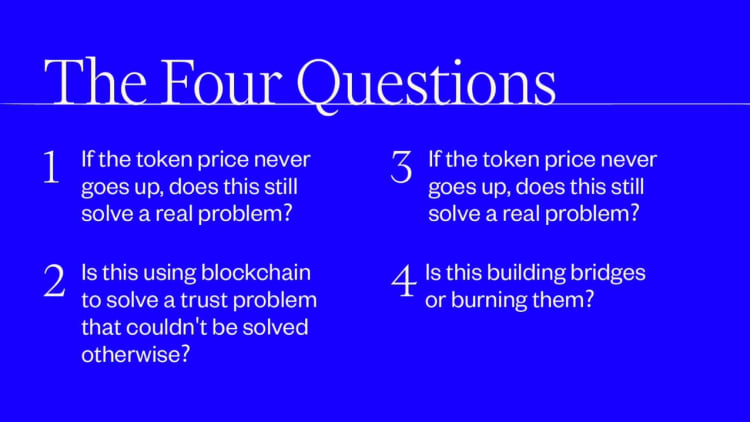
3. Could my parents use this without knowing it's crypto?
T2 World reimagined content platforms by creating a community where writers and readers can collaborate, remix content, and earn rewards based on contributions.
What makes T2 different from earlier crypto publishing platforms is that they've attracted over 3,000 writers and 12,000 readers – most without prior crypto experience. Users earn "time points" for engagement (similar to Reddit karma), creating incentives for participation without requiring users to understand blockchain.
4. Is this building bridges or burning them?
This question is more nuanced. Some crypto projects must challenge existing systems – that's the nature of innovation. But there's a difference between thoughtful disruption and nihilistic destruction.
Sablier pioneered on-chain token streaming, allowing tokens to flow continuously by the second rather than in discrete transactions. This enables new payment models for salaries, commissions, and subscriptions that weren't possible before.
While this certainly disrupts traditional payment models, it does so by creating new possibilities rather than simply attacking existing systems.
The Red Flags
Just as important are the warning signs that make me walk away:
- Founders who seem opportunistic rather than authentic
- Projects focused solely on short-term market moves without underlying value
- Overly niche solutions that don't have platform potential
I've passed on projects that went on to generate significant returns in bull markets. That's part of the VC game – no one gets every call right. And while speculation drives liquidity and attention that the ecosystem needs, as a venture investor with a 7-10 year horizon, I need to look beyond market cycles.
Looking Beyond the Hype
I believe the next wave of crypto adoption will be driven by businesses that use blockchain infrastructure to solve real problems for real people – often without those people even realising they're using crypto.
As a VC, my job isn't primarily to time market cycles or predict the next narrative shift. It's to find founders building businesses that would be impossible without blockchain but create enduring value through market ups and downs.
If you're building in this space and your vision passes the Skeptic Test, I'd love to connect!
Written bY
Nawaz Ahmed


.png)
.png)
